
Taiwan Truly Surprised Me…
The Weekly Frame #21: April 2nd, 2026

Hi friends,
I know it’s been coming for a few weeks now, but my Taiwan travel series finally went live this week! A lot of people had the same reaction I did: they'd never really considered Taiwan as a serious destination… as much as they ought to.
The Taiwan Tourism Administration invited me out, and I went in with zero expectations and came home completely rethinking my list of underrated countries. It's visually stunning, affordable, easy to get around, and the food alone is worth the flight.
The morning we spent at Sun Moon Lake was one of those moments where I just stood there for a while before even reaching for my camera. Mist low on the water, lanterns overhead, mountains layered behind it all… it was just so stunning.
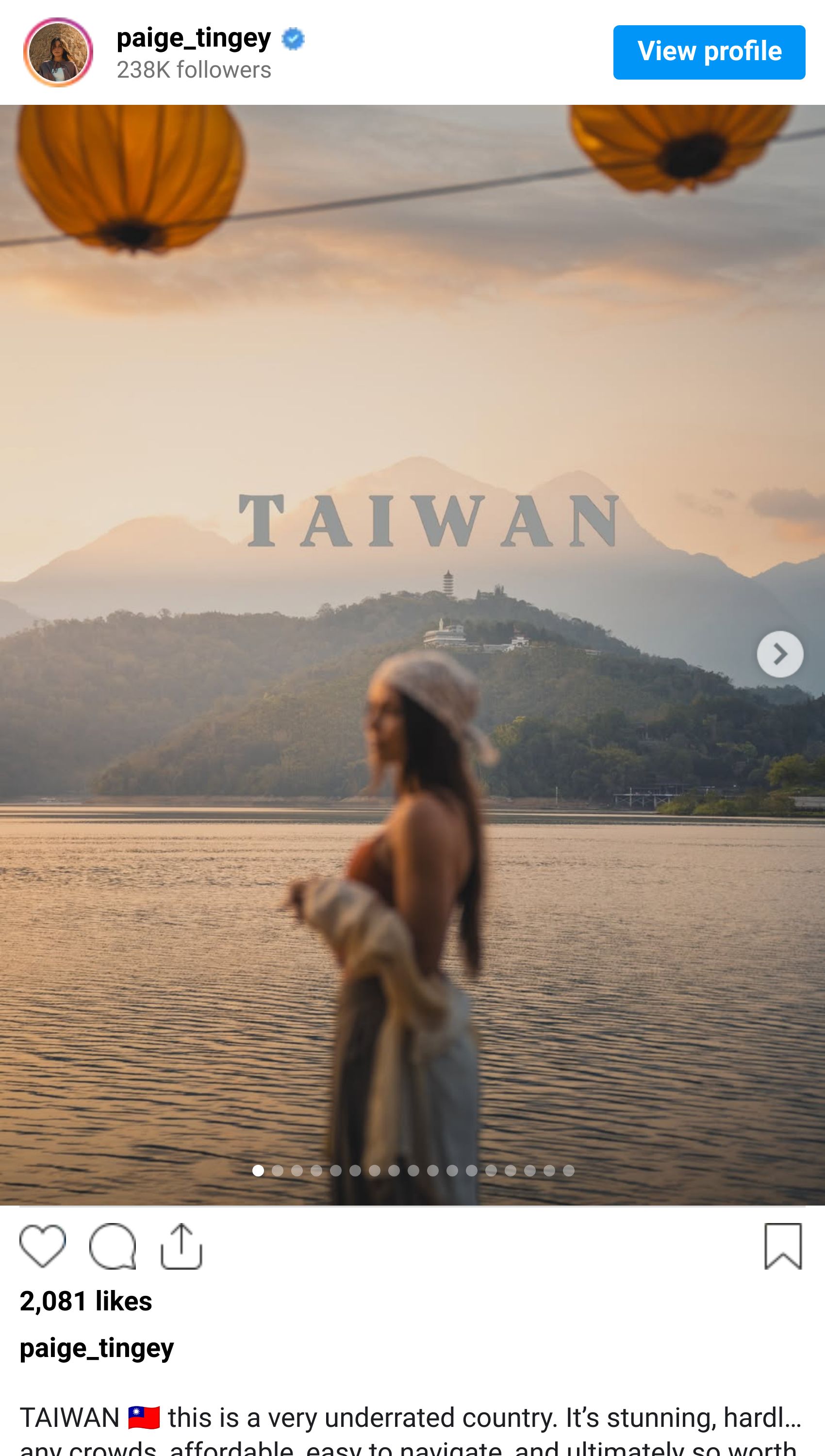
This week's tip is something that connects directly to what I was shooting in Taiwan, and it's a question I've been getting more and more: how to photograph water so it actually looks the way it felt when you were standing there.
Tip of the Week: How to Photograph Water (and Make It Look the Way It Felt)

Water is one of those subjects that seems simple until you try to shoot it. You're standing at the edge of a lake at sunrise, the whole scene is beautiful, and then you look at your LCD and wonder why it looks so flat.
I photographed a lot of water in Taiwan, and it reinforced something I keep coming back to: the key to photographing water well isn't one technique. It's knowing which approach fits the moment you're in.
Stillness vs. motion. A glassy lake and a rushing waterfall need opposite treatments. For still water, you want calm air (early morning is almost always your best window), a tripod, and a shutter speed fast enough to preserve the reflection without introducing any blur. For moving water, slowing the shutter down to anywhere from 1/4 second to a few seconds creates that smooth, flowing quality that draws the eye through the frame.
Shutter speed is really the biggest decision. Fast shutter speeds (1/500 and up) freeze individual droplets and splashes. Slower speeds (1-2 seconds) smooth everything into something calmer and more dreamlike. Neither is correct. The question is whether you want to show energy or serenity, and once you start framing it that way, the technical decision becomes intuitive.
Get low for stronger reflections. This connects to a tip from a few weeks back about shooting low for foreground interest. Dropping closer to the water's surface reduces the angle and often strengthens reflections dramatically. The difference between eye level and a foot above the water can be the difference between a decent photo and one that stops someone mid-scroll.
A polarizing filter is your best friend. A circular polarizer can either enhance or reduce reflections depending on how you rotate it. Want the mirror effect? Dial it one way. Want to see through to the rocks below? Rotate the other direction. It's one of the most immediately useful tools for water photography, and the effect genuinely cannot be replicated in post.
Try this: next time you're near water, shoot the same composition at three different shutter speeds. Compare them when you get home. You'll start building an instinct for which treatment fits which scene.
What's Happening in Photography Right Now

Sony halts memory card orders in Japan. Sony Japan announced on March 27 that it would immediately stop accepting new orders for the majority of its CFexpress and SD cards across the Japanese market, including its entire TOUGH line. The company cited global semiconductor shortages driven by AI datacenter demand consuming NAND flash supply at unprecedented rates. The suspension currently applies only to Japan, but industry analysts expect similar constraints could spread globally.
Kodak is renaming its most iconic film stocks. Eastman Kodak completed the final phase of pulling film distribution back from Kodak Alaris, the entity that had handled still photography film sales since the 2012 bankruptcy. Portra is becoming Ektacolor Pro, Gold is now Kodacolor, and Ektachrome becomes Ektapan. The emulsions appear to be the same, and Kodak says the consolidation is aimed at improving supply stability and reducing the price volatility that film shooters have dealt with for years.
A comet is heading dangerously close to the sun this week. Comet MAPS (C/2026 A1), a sungrazing comet first discovered in January, reaches its closest approach to the sun on April 4 at just 487,000 miles from the surface. Whether it survives or breaks apart is genuinely unpredictable, but if it holds together, look low in the western sky after sunset from mid-northern latitudes. April is also prime astrophotography season with the Full Pink Moon on April 1 and the Lyrid meteor shower later in the month.
Creator Highlight: Cristina Mittermeier (Conservation Photography, Co-Founder of SeaLegacy)

Cristina Mittermeier is a marine biologist turned conservation photographer and the co-founder of SeaLegacy, an organization that uses visual storytelling to drive ocean conservation. Her photographs have been published in National Geographic and have been credited with influencing conservation policy in multiple countries.
What I find compelling about Cristina's work is how she balances visual beauty with purpose. Her underwater and coastal images are technically stunning, but every project is tied to a specific conservation outcome.
She's spoken openly about using photography not just to document what exists but to protect it, and in a world where AI-generated nature imagery is becoming more common, her commitment to real, on-location storytelling feels more important than ever.
Gear Worth Mentioning: WANDRD Tech Bag

Last week I mentioned the WANDRD PRVKE 31L as my go-to camera backpack. This is its companion piece.
The Tech Bag is a small organizer pouch designed to hold all the stuff that usually ends up loose at the bottom of your bag: charging cables, memory cards, spare batteries, adapters, lens wipes. It has internal pockets and elastic loops that keep everything separated and easy to find, which sounds minor until you're digging through your pack at golden hour looking for a fresh SD card.
The part that makes it work with the PRVKE specifically is the gatekeeper clip system on the back panel. You can attach it directly to the outside of the backpack using the accessory strap loops, so it rides on the front of your bag without taking up any internal space. Or detach it and use it on its own with the optional carry strap.
At around $50, it's one of those small purchases that just removes friction from your workflow. Everything has a spot, nothing rattles around, and you stop wasting time looking for things.
(Full transparency: I earn a small commission through this link. It helps keep this newsletter free and my coffee mug full. Thanks for supporting!)
One More Thing…

That's it for this week. Taiwan is still very much on my mind, and I have a lot more content to share from the trip in the weeks ahead.
April is one of those months that feels like a reset. The light is getting longer, the weather is shifting, and if you're anything like me, you're starting to think about where you want to go next and what you want to shoot this year. I've been spending a lot of my evenings this week editing and organizing, which is less glamorous than being on location but just as important. The work between trips is where you actually figure out what you're learning.
This week's question: What destination has completely surprised you? Somewhere you had zero expectations going in and it ended up being one of your favorites. I'd love to hear about it, so hit reply and tell me.
See you next week,
Paige
P.S. Curious how I edit my photos? These are the exact presets I use for almost every travel & landscape shoot (designed for both mobile and desktop).