
The Weekly Frame #12: Focal Lengths Explained (and Why Egypt Still Has Me Thinking)

Hi friends,
If you’ve ever looked at a lens and wondered what those numbers really mean (35mm, 50mm, 70-200mm), you’re not alone.
Which one should you buy? Which one should you take on your hike? Which one should you travel with?
I've been putting together a video breaking down focal length to help you be the best photographer you can be, and going through it has reminded me how confusing this stuff can be when you're starting out.
But first, Egypt.
I posted a new carousel this week showing some of my favorite moments from that trip.
The ancient temples at Luxor. That surreal mosque with its towering minarets. The hot air balloon drifting over the Valley of the Kings at sunrise.
And of course, the pyramids in Giza. Standing there, feeling so incredibly small, really puts things into perspective. (I still don’t understand how they exist…)
Some trips you process and move on from. But Egypt? I already need to go back.
I challenged myself to post in a vertical grid to capture the different feelings of the trip all in a single frame, and I’m really happy with how it turned out.
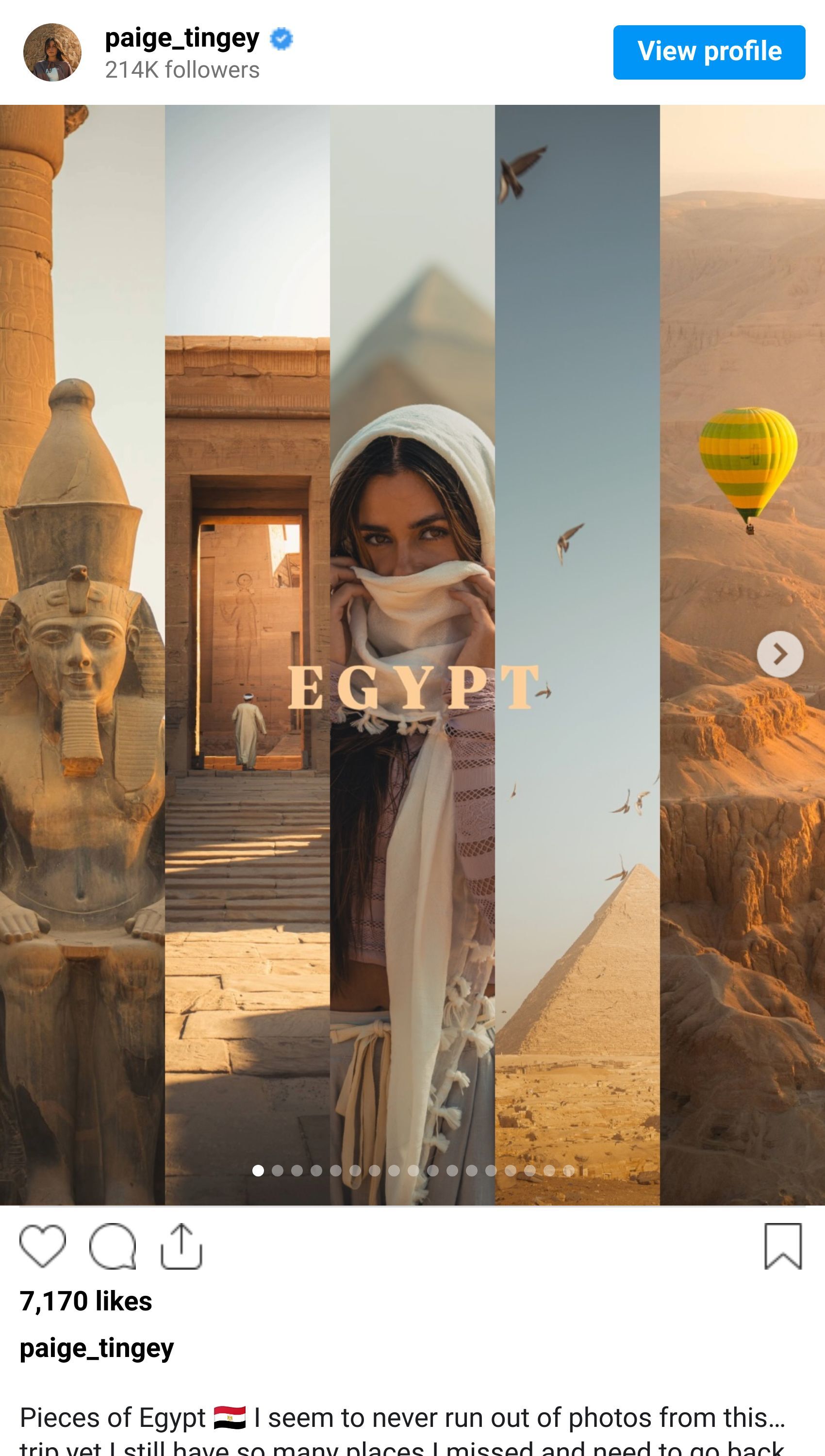
As far as how this week has gone, it’s been a lot of behind-the-scenes work. I did spend a few days creating and editing a video for Adobe, which I’m really excited about. (Can’t wait for you to meet Alt Ego Paige!)
The team is launching some new features for Lightroom and Photoshop that are gonna be really helpful. Can't share too many specifics yet, but if everything goes according to plan, the video should be live Monday so stay tuned!
Tip of the Week: Focal Length Explained (Part 1)

Here's the simple version: Focal length is measured in millimeters, and it describes how much of the scene your lens sees.
Smaller number = wider view. Bigger number = tighter view.
16-35mm → Wide view, great for landscapes, interiors, travel shots where you want context and environment.
24-70mm → Middle ground, natural perspective similar to how your eye sees.
85mm-200mm → Tight view, isolates your subject, compresses backgrounds, makes faraway things appear closer. (This is why portraits, wildlife, and details in busy environments often feel more “cinematic” at longer focal lengths.)
One thing that trips people up: Focal length is NOT the same as zoom quality or image sharpness.
A 35mm lens isn't lower quality than an 85mm lens… They just see the world differently.
You can buy a $200 lens at 16mm or a $3,000 lens at 16mm (the number doesn't determine quality). That comes from the lens design, the glass, and your technique.
And while we’re clearing things up: prime lenses have one focal length (like 35mm), so you move your body to reframe. Zoom lenses cover a range (like 24–70mm), so you twist the lens to reframe.
Neither is “better” - they just have different pros and cons. Primes tend to be smaller, lighter, and often sharper; zooms give you flexibility when you can't move around.
I'm working on a more in-depth video about this (part one of two), but knowing which lens to grab before you shoot? That starts with understanding what focal length actually does.
What's Happening in Photography Right Now

Martin Parr retrospective opens at Jeu de Paume in Paris. "Global Warning" spans 50+ years of Parr's work - over 180 images exploring mass tourism, consumer excess, and our relationship with the environment. If you're into documentary photography or just appreciate someone who sees the absurdity in everyday life, this is worth knowing about. Runs through spring.
Ricoh released the GR IV Monochrome. A dedicated black-and-white only version of the popular GR IV compact camera. It eliminates the color filter array on the sensor, which improves low-light performance and sharpness. At $2,200, it's a serious commitment to shooting exclusively in monochrome, but if you're into that, it's one of very few cameras offering this at a non-Leica price point.
Fujifilm announced the Instax Mini Evo Cinema. A hybrid instant camera that shoots both photos and 15-second video clips, then prints them with a QR code so people can watch the video. It's designed around a retro 8mm camcorder aesthetic with an "Eras Dial" that applies different decade-inspired looks (1960s film grain, 1980s VHS vibes, etc.). Quirky? Absolutely. But Fujifilm keeps proving there's appetite for cameras that prioritize fun over specs.
Gear Worth Mentioning: The Best Outdoor Photographer’s Backpack

If you're more of a hiker/adventurer (like I am) than a city shooter, the Shimoda Action X25 is built for that.
It's designed for outdoor photographers who need to carry gear while moving through rough terrain - padded hip belt, hydration-compatible, and modular inserts so you can customize the layout.
I have the yellow backpack myself, but all their different colors look really classy (I especially love the army green one). And be sure to check out their other sizes if you need extra space.
I've used this bag on longer backcountry shoots, many international trips, and steep mountain hikes where weight distribution actually matters. It's not cheap, but for multi-hour hikes with hefty camera gear, it definitely earns its spot.
(Full transparency: I earn a small commission through this link. It helps keep this newsletter free and my coffee mug full. Thanks for supporting!)
One More Thing…

Here's something I've been thinking about while planning this focal length video: most photographers (myself included) started by just buying a random lens without understanding why they were choosing one over another.
We'd reach for a 50mm because someone said it's a good place to start. We'd buy a 70-200mm because we saw portfolio shots that looked compressed and dreamy. But we didn't understand why those focal lengths were used in those scenarios.
Once you understand that wide lenses show more context and longer lenses isolate subjects, your decisions become more and more intentional. Knowledge is truly power.
You're not guessing, you're deciding. And that decision happens before you even raise the camera or even before you hop on your flight to see a brand new place. And that's the difference between being lucky that you had the right lens and being prepared when you need that specific lens.
I’m curious… what's your go-to focal length? The one you'd grab if you could only bring one lens on a trip. Hit reply and tell me, I'd love to see what everyone's shooting with.
See you next week,
Paige
P.S. Interested in Lightroom Presets? Check out my Preset Packs below, made specifically for travel, landscape, & nature. These are the same presets I use for almost every shoot.